

How to Batch Cook Healthy Weeknight Meals in 3 Hours
Quick Summary
Batch cooking means preparing several meals or meal components in one session, then portioning them for later. Plan a protein, a grain, and two vegetables, flavor them differently each night, and set up a timed three-hour cooking day. Cool food quickly in shallow containers and label everything with its date.
- Plan one protein, one grain, and two vegetables, then vary seasonings across the week.
- Set up a three-hour plan with overlapping tasks: oven vegetables, grains, and protein run in parallel.
- Cool cooked food in shallow containers no more than 2 inches deep before refrigerating.
- Refrigerate cooked meat, poultry, and seafood for 3 to 4 days, and cooked grains and legumes for 3 to 5 days.
- Freeze leftovers you will not eat within their refrigerator window, and label every container with the date.
Table of Contents
- Why Batch Cooking Works for Busy Weeknights
- Plan Your Weekly Menu Around Mix-and-Match Components
- Build a Shopping List and Prep Your Ingredients
- Run a Timed Cooking Day in Three Hours
- Cool, Store and Freeze Batch-Cooked Food Safely
- Batch Cooking for Beginners: Starting Small and Adjusting
- Start Your First Batch Cooking Session This Weekend
- Frequently Asked Questions
Batch cooking is one of the most practical ways to get healthy dinners on the table during a busy week. Twisted Pepper Co. has built its seasoning and soup mixes around the same idea: flavorful meals that come together fast.
Batch cooking means preparing several meals or meal components in one session, then portioning them for later. The National Institutes of Health's guidance on healthy eating supports planning meals ahead as a way to make nutritious choices easier to keep up NIH healthy eating and meal planning guidance.
Why Batch Cooking Works for Busy Weeknights
Weeknights are when good intentions go to die. You are tired, hungry, and tempted by takeout. Batch cooking removes the decision entirely.
Here is what a few hours of cooking buys you:
- Dinners that are already planned and portioned
- Less money spent on delivery and last-minute groceries
- Fewer dishes and less cleanup on busy nights
- Meals you can control for salt, fat, and portion size
Harvard's Nutrition Source recommends collecting healthy recipes, planning meals, and starting with enough dinners for the week Harvard T.H. Chan meal prep guide. That is the approach this guide follows.
Plan Your Weekly Menu Around Mix-and-Match Components
Do not plan five separate recipes. Plan a few components you can mix and match.
For example, cook one protein, one grain, and two vegetables. Then flavor them differently across the week. Taco seasoning turns the protein into taco filling. The same protein can go over rice with a different seasoning on another night.
Try this simple formula:
- 1 protein: chicken, ground turkey, or beans
- 1 grain: rice, quinoa, or pasta
- 2 vegetables: roasted peppers, broccoli, or carrots
- 2 to 3 seasonings or soup bases to change the flavor
Our Taco Seasoning Mix 2 oz. ($6.00) can be used with batch-cooked ground beef for quick tacos. Taco Seasoning Mix 2 oz. is a good starting point if you want one flavor that works across several dinners.

Build a Shopping List and Prep Your Ingredients
Start with the week's menu, then write one list organized by store section. Produce, meat, pantry, and dairy are the usual groups. Buying in one trip keeps your cooking day short.
Before you start cooking, do the prep work:
- Wash and chop vegetables in advance
- Measure out dry seasonings into small bowls or jars
- Check that you have enough containers for the full week
- Pull frozen items out to thaw if you need them
Soup nights are an easy add-on. Our Pasta e Fagioli Dry Soup Mix ($9.99) is made with water, pasta, beans, and cooked meat, so it can fit into a batch plan. For a comforting option, the Pasta e Fagioli Dry Soup Mix takes the guesswork out of seasoning a large pot.

Run a Timed Cooking Day in Three Hours
A realistic schedule matters more than a perfect recipe. The trick is not cooking faster, it is overlapping tasks so the oven, stovetop, and your own hands are all working at once. Here is a sequenced three-hour plan built around parallel tasks, with time estimates you can adjust to your kitchen. Efficiency extends beyond the main meal when you repurpose kitchen trimmings into flavorful bases that simplify your future cooking sessions.
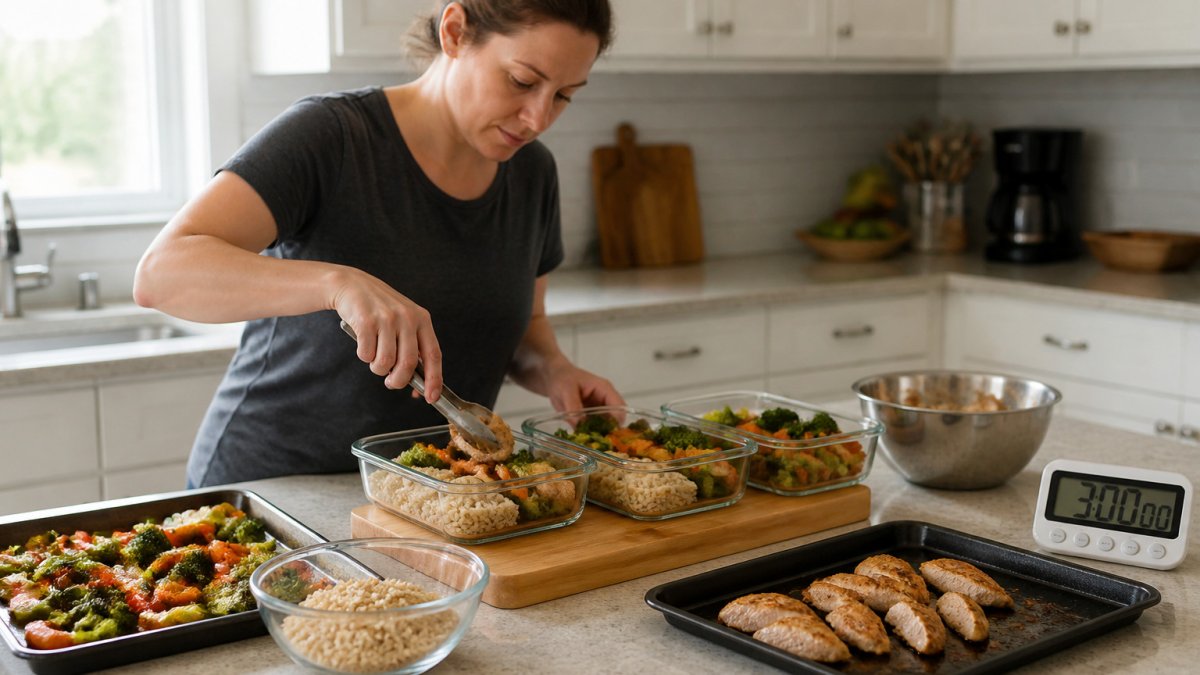
Before the clock starts (15 minutes)
- Preheat the oven to 425°F and set out your containers.
- Pull out everything you prepped: chopped vegetables, measured seasonings, thawed proteins.
- Fill a large pot with water for grains or pasta and put it on to boil.
Hour 1, start the long items and the oven (0:00-1:00)
- 0:00-0:10: Get the oven going with the longest-roasting vegetables (carrots, potatoes, squash) on one sheet pan.
- 0:10-0:20: Start grains on the stovetop. Rice and quinoa both take about 15-20 minutes once boiling.
- 0:20-0:45: Brown the protein in a large skillet. While it cooks, stir the grains and check the oven vegetables.
- 0:45-1:00: Add quicker-cooking vegetables (broccoli, peppers) to a second sheet pan and put them in the oven. Start any soup or sauce on a back burner.
Hour 2, finish cooking and build flavor (1:00-2:00)
- 1:00-1:20: Finish the protein and divide it into two or three portions, seasoning each differently. This is where one protein becomes taco filling, a stir-fry base, and a salad topper.
- 1:20-1:40: Pull the quick vegetables from the oven; check the long-roasting pan. Stir the soup or sauce.
- 1:40-2:00: Cook pasta if your plan includes it, using the same pot of boiling water. Drain and toss with a little oil so it does not stick.
Hour 3, cool, portion, and clean (2:00-3:00)
- 2:00-2:20: Let food cool briefly, then portion into shallow containers. Label each with the dish name and date.
- 2:20-2:40: Load the dishwasher or wash pots and pans while the food cools further.
- 2:40-3:00: Wipe counters, put containers in the refrigerator or freezer, and note on your list what you made.
Make the plan work for your kitchen
- If you have one oven, roast vegetables in sequence rather than all at once, and use the stovetop for grains and protein in parallel.
- If you have a slow cooker or Instant Pot, use it for the soup or beans so it runs hands-free while you work on other components.
- Write the sequence on a sticky note and cross off tasks as you go, it keeps the session moving and shows you where time is actually going.
Better tools shave minutes off the work. Our guide on time-saving kitchen tools for healthy cooking covers equipment that speeds up prep and cooking.
The article's three-hour plan breaks down into these stages, with the time each one takes.
| Stage | Task | Time |
|---|---|---|
| Before the clock starts | Preheat oven to 425°F and gather prepped ingredients | 15 minutes |
| Hour 1 | Roast longest vegetables, start grains, brown protein | 0:00-1:00 |
| Hour 2 | Finish protein, portion and season, cook pasta | 1:00-2:00 |
| Hour 3 | Cool, portion into containers, clean up | 2:00-3:00 |
Cool, Store and Freeze Batch-Cooked Food Safely
Food safety matters a great deal when batch cooking. The goal is simple: move cooked food through the temperature danger zone (40°F to 140°F) as quickly as possible, then store it so you can actually find and use it later.
Cool food fast, not on the counter
- Divide large pots into shallow containers no more than 2 inches deep before refrigerating. A big stockpot of chili can take hours to cool in the fridge, which keeps it in the danger zone too long.
- Leave containers uncovered until the food stops steaming, then seal them. Trapping heat slows cooling.
- Do not stack warm containers tightly; leave space between them so air can circulate.
- A common pattern is to portion into single-meal containers right away rather than storing one giant batch and re-portioning later.
The USDA's FoodSafety.gov guidance on cooling and storing cooked food is a reliable reference when you are unsure USDA FoodSafety.gov leftovers and food storage guidance.
Refrigerator and freezer time limits
Use these as working targets, and label every container with the date it was cooked:
- Cooked meat, poultry, and seafood: 3 to 4 days in the refrigerator.
- Cooked grains, pasta, and legumes: 3 to 5 days in the refrigerator.
- Cooked vegetables: 3 to 5 days in the refrigerator.
- Soups and stews: 3 to 4 days in the refrigerator.
- Frozen leftovers: 2 to 3 months for best quality, though frozen food kept at 0°F stays safe indefinitely.
Freeze for quality, not just safety
- Cool food completely in the refrigerator before freezing. Freezing warm food raises the freezer temperature and can affect everything else in it.
- Freeze in portions you will actually thaw. A two-pound block of sauce takes far longer to thaw than four half-pound containers.
- Press air out of freezer bags or use containers with tight lids to reduce freezer burn.
- Freeze soups and sauces flat in bags so they stack and thaw quickly.
Label and rotate so nothing gets lost
A simple labeling system prevents the "what is this and when did I make it" problem:
- Write the dish name and the date cooked on every container, using tape and a marker or freezer-safe labels.
- Keep a running list on the fridge door or your phone of what is in the freezer, and cross items off as you use them.
- Practice first-in, first-out: eat the oldest containers first and push newer ones to the back.
- Group like items together, proteins on one shelf, soups and sauces on another, so you can see what you have at a glance.
Reheat safely
Reheat leftovers until they are steaming hot all the way through, and stir so heat distributes evenly. Reheat only the portion you plan to eat rather than the whole batch, and never reheat the same portion more than once. Seasoning blends keep their flavor best when stored sealed and away from heat and light. For that, see our guide on how to reduce sodium in processed foods and how to store spice blends for maximum freshness.
Batch Cooking for Beginners: Starting Small and Adjusting
You do not need to cook for the whole week on day one. Start with three or four dinners. Once that feels easy, add more.
Keep these tips in mind:
- Choose two or three recipes you already like
- Cook one large batch of one component before adding more
- Note what you wasted or ran out of, then adjust next week
- Freeze extras so nothing spoils
A common beginner mistake is making too many different dishes at once. Stick to a few components and vary the seasoning instead.
Start Your First Batch Cooking Session This Weekend
Pick three weeknight dinners, write one shopping list, and block off three hours this weekend. Use the mix-and-match formula, cool and store food promptly, and label every container.
Twisted Pepper Co. makes it easy to get started. Our handcrafted, gluten-free seasoning and soup mixes are made with no MSG added, and our soup is ready in 30 minutes or less. Shop Now and build your first batch of healthy weeknight meals.
Frequently Asked Questions
What are some ideas for big-batch meal prep?
Good starting points are a large pot of chili, a sheet pan of roasted chicken and vegetables, a batch of rice or quinoa, and a pot of soup. Pair one protein, one grain and two vegetables so the components can be mixed into different meals across the week. Twisted Pepper Co.'s Pasta e Fagioli Dry Soup Mix and Creamy Chicken & Rice Dry Soup Mix are both designed to make a full pot, serving 10 and 8+ respectively, so they suit big-batch cooking well.
Is batch cooking the same as meal prep?
They overlap but are not identical. Batch cooking means cooking a large quantity of one or more components at once, often to eat across several days. Meal prep usually means portioning complete meals into containers ready to eat. Most weeknight routines use both: batch cook the components, then assemble them into individual meals as needed.
How long do batch-cooked meals last in the refrigerator?
Cooked leftovers are generally safe for three to four days in the refrigerator when cooled promptly and stored in airtight containers, . Meals you will not eat within that window should be frozen, where they keep their quality for several months. Label each container with the date and reheat leftovers until steaming hot throughout.
How can I keep batch-cooked dinners from feeling repetitive?
Cook one base component in bulk, then change the seasoning and final assembly for each meal. A shredded chicken base can become tacos one night and a rice bowl the next. Seasoning blends such as Twisted Pepper Co.'s Taco Seasoning Mix let you change the flavor profile quickly without cooking a new recipe.
