

How to Cook Flavorful Food Without MSG: 7 Easy Steps
Table of Contents
- Why MSG-Free Cooking Still Tastes Great
- MSG Substitutes for Cooking: Your Flavor Toolkit
- How to Add Umami Without MSG in 5 Steps
- Natural Umami Ingredients That Build Savory Depth
- Low-Sodium Flavoring Ideas for Healthier Meals
- Recipe-by-Recipe Substitution Guide for Flavorful Food Without MSG
- Common Mistakes When Cooking Without MSG
- Conclusion: Start Cooking Flavorful Food Without MSG Today
- Frequently Asked Questions
Last Updated: October 15, 2026
Why MSG-Free Cooking Still Tastes Great
Monosodium glutamate is a flavor enhancer, not a flavor itself.
MSG is the sodium salt of glutamic acid, an amino acid found naturally in tomatoes, mushrooms, aged cheese, and fermented sauces.
At Twisted Pepper Co., we build our seasoning blends around that idea.
Below, we'll walk through the exact steps, the best swaps, and the mistakes that leave MSG-free food tasting flat.
MSG Substitutes for Cooking: Your Flavor Toolkit
The best MSG substitutes for cooking are ingredients you probably already own: soy sauce, fish sauce, aged Parmesan, tomato paste, dried mushrooms, and anchovies. Each one brings glutamates plus its own character, so you get complexity instead of a one-note boost.
Here's how to think about your toolkit:
- Fermented sauces (soy, fish, Worcestershire) add salty depth fast
- Aged cheeses (Parmesan, Pecorino) bring umami plus richness
- Dried mushrooms deliver concentrated savory notes
The FDA's guidance on glutamate and MSG labeling confirms that glutamate occurs naturally in many foods, which is why these swaps work without any additives.
Natural Glutamates in Everyday Ingredients
Natural glutamates show up in more of your pantry than you'd expect. Ripe tomatoes, cured meats, seaweed, green tea, and even human breast milk contain them. That's why a slow-simmered tomato sauce tastes rich with nothing but vegetables and time.
Stock your kitchen with a few high-glutamate staples and you'll rarely miss the shaker.
How to Add Umami Without MSG in 5 Steps
Learning how to add umami without MSG comes down to five repeatable moves, used in order. The sequence matters because each step builds on the last: aromatics create a fat-soluble base, fermented sauces and mushrooms add glutamates, broth carries them through the dish, and acid plus aged cheese sharpen the finish so the savory notes read clearly instead of tasting muddy.
Here is the method with starting amounts for a dish that serves four. Treat every number as a starting point and taste as you go.
- Brown the aromatics first. Heat 1 to 2 tablespoons of oil over medium heat, then add 1 diced onion and cook 5 to 7 minutes until translucent. Add 2 to 3 minced garlic cloves and cook 30 to 60 seconds more, just until fragrant. Garlic goes in last because it burns in under a minute at this heat and turns bitter.
- Add a fermented sauce. Stir in 1 tablespoon of soy sauce, fish sauce, or Worcestershire and let it sizzle for about 30 seconds. This step deglazes the pan and concentrates the sauce's glutamates onto the aromatics rather than into the liquid.
- Layer in mushrooms. Add 4 ounces of sliced fresh shiitake or cremini, or 1 teaspoon of dried mushroom powder. Cook until the mushrooms release their liquid and it evaporates, roughly 5 minutes. Dried powder is the stronger move in wet dishes because the glutamate is concentrated.
- Pour in broth or stock. Add 1 to 2 cups of beef, chicken, or mushroom broth and simmer 10 minutes. Simmering, not just stirring, is what lets the glutamate compounds disperse evenly through the dish.
- Finish with acid and aged cheese. Off the heat, add 1 to 2 teaspoons of lemon juice or vinegar and 1 to 2 tablespoons of grated Parmesan or Pecorino. Acid lowers the pH slightly, which makes savory notes taste brighter, and the cheese adds both glutamate and fat.
Why the Order Works
Glutamate is water-soluble, so it needs liquid to spread through a dish, but it is also heat-stable, which means a long simmer will not destroy it. That is why steps 3 and 4 can happen in either order in a soup but should stay in sequence in a stir-fry, where there is little liquid to carry flavor. Fat matters too: many umami compounds are fat-soluble, so browning aromatics in oil first gives those flavors somewhere to go.
Scaling the Method by Dish Type
- Soups and stews: double the broth step and add the acid at the table, since acid fades with long cooking.
- Stir-fries: skip the broth, use 1 tablespoon soy sauce plus 1 teaspoon fish sauce, and add acid off the heat.
- Sauces: start with 2 tablespoons tomato paste in step 2 alongside the fermented sauce for body.
That is the core method. The rest of this guide shows you how to apply it dish by dish.
Natural Umami Ingredients That Build Savory Depth
The strongest natural umami ingredients fall into three families: mushrooms, broths and stocks, and aged cheeses. Together they cover almost every cuisine you cook at home.
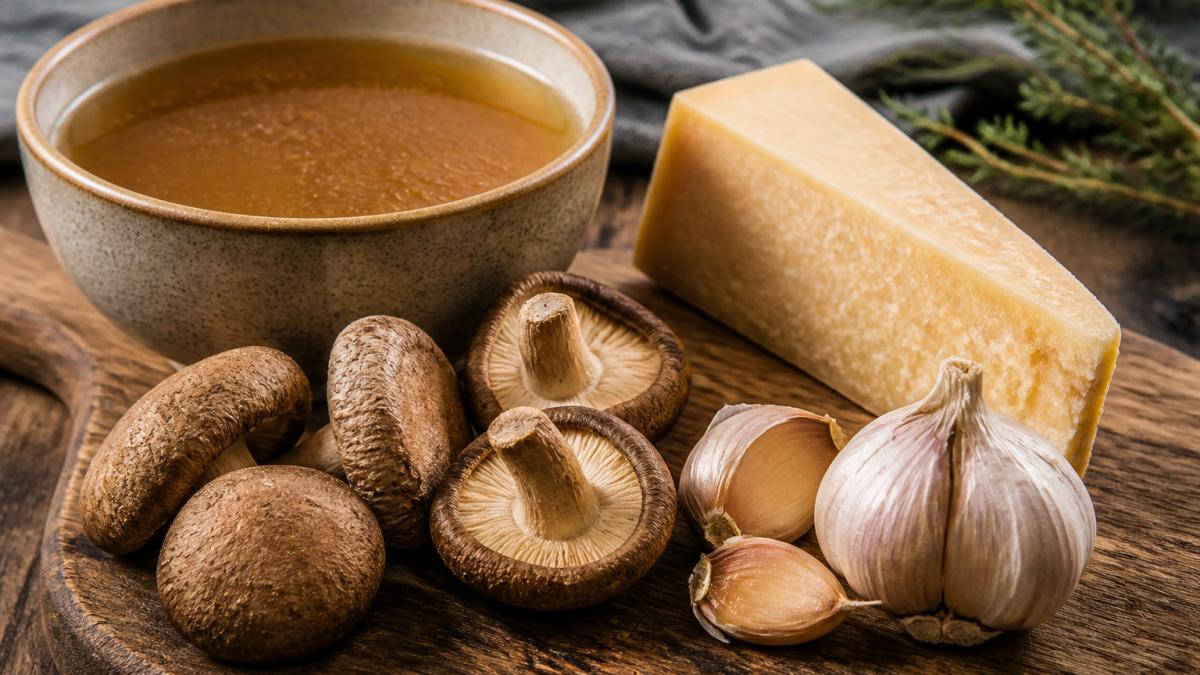
Mushrooms, Broths, and Aged Cheeses
Dried shiitake mushrooms are the workhorse here. Soak them and use the liquid, and you've made a free umami stock.
Broths and stocks do the heavy lifting in soups, grains, and sauces. Simmer bones or vegetables long enough and the liquid turns savory on its own.
Aged cheeses like Parmesan and Pecorino are glutamate powerhouses. A small handful stirred into risotto or pasta changes the whole dish.
Low-Sodium Flavoring Ideas for Healthier Meals
Low-sodium flavoring ideas work best when you replace salt with layered taste rather than just cutting it. Salt makes food taste salty; umami makes it taste satisfying. Those are different jobs, and the swap only works if you understand how much sodium each substitute actually carries.
Tuscan Roasted Garlic Seasoning 2.0 oz. →
The Sodium Math Behind Common Substitutes
Sodium content varies enormously across the ingredients this article recommends, and that matters if you are cooking for a low-sodium diet. Approximate sodium per teaspoon:
- Table salt: about 2,300 mg
- Soy sauce: about 280 to 350 mg
- Fish sauce: about 1,300 to 1,500 mg
A common pattern is to swap 1 teaspoon of salt for 1 tablespoon of soy sauce plus a squeeze of lemon. You lose roughly half the sodium and gain glutamate depth, but you also gain liquid, so reduce another liquid in the recipe by about a tablespoon. Fish sauce is the trap here: it delivers strong umami but nearly as much sodium per teaspoon as the salt you removed, so use it in drops, not spoonfuls.
Swaps That Actually Lower Sodium
- Lemon and lime juice brighten dishes so they need less salt; start with 1 teaspoon per serving
- Vinegar (balsamic, red wine, rice) adds tang and complexity; 1 to 2 teaspoons finishes a sauce
- Fresh herbs like basil, parsley, and cilantro add aroma; add delicate herbs off the heat
The CDC's guidance on reducing sodium intake notes that most sodium in the average diet comes from processed and restaurant food, not the shaker. Cooking at home with real ingredients already puts you ahead, which is why the swaps above matter more than the salt you skip at the table.
Added MSG vs. Naturally Occurring Glutamate
This is the distinction most guides skip. The FDA's guidance on glutamate and MSG labeling explains that glutamate occurs naturally in many foods, and that is why these ingredients taste savory on their own.
On a label, the two are treated differently. "No MSG added" means the manufacturer did not add monosodium glutamate as an ingredient, but the product may still contain naturally occurring glutamate from tomato, cheese, or yeast.
Dietary and Allergen Considerations
Not every umami substitute works for every eater, and the list above includes several common conflicts:
- Vegetarian and vegan: skip fish sauce, anchovies, Worcestershire (usually contains anchovies), and Parmesan (made with animal rennet). Use soy sauce, miso, tomato paste, dried mushrooms, and nutritional yeast instead.
- Gluten-free: standard soy sauce contains wheat. Use tamari or coconut aminos, and check Worcestershire and broth labels.
- Soy-free: replace soy sauce with coconut aminos, fish sauce, or mushroom stock.
This is where low and light sodium blends earn their place. Twisted Pepper Co. builds our seasonings so you control the salt at the table, not in the mix.
Recipe-by-Recipe Substitution Guide for Flavorful Food Without MSG
Here's the practical part most guides skip: what to swap, dish by dish.
| Dish | Instead of MSG, Use | Amount | Why It Works |
|---|---|---|---|
| Stir-fry | Soy sauce + toasted garlic | 1 tbsp + 1 tsp | Fermented depth plus aroma |
| Soup | Beef broth + dried mushrooms | 2 cups + 4 mushrooms | Two glutamate sources stack |
| Pasta sauce | Tomato paste + anchovy | 2 tbsp + 1 fillet | Melts in, adds richness |
| Roasted veggies | Parmesan + olive oil | 2 tbsp + 1/4 cup | Aged cheese carries umami |
| Marinade | Fish sauce + citrus | 1 tbsp + 2 tbsp | Salty depth balanced by acid |
| Grains | Mushroom stock + soy | 1 cup + 1 tsp | Savory liquid cooks right in |
For a shortcut on any of these, our Tuscan Roasted Garlic Seasoning handles the garlic and Italian spice layer in one sprinkle. It's low sodium, gluten free, and has no MSG added. Mix one to two tablespoons with a quarter cup of olive oil for an instant marinade.

Common Mistakes When Cooking Without MSG
The biggest mistake is cutting MSG and adding nothing in its place. Flavor has to come from somewhere, and if you just remove the shaker, the dish tastes thinner.
Other traps to avoid:
- Relying on salt alone. More salt doesn't create umami. It just makes food salty.
- Skipping acid. A squeeze of lemon at the end wakes up a dull dish instantly.
- Buying blends without checking labels. "No MSG added" and "MSG free" aren't always the same claim.
Many commercial seasoning blends hide glutamates under names like "hydrolyzed protein" or "autolyzed yeast extract." If a label lists those, it isn't truly MSG-free. Read the ingredient panel, not just the front of the jar. ::: Natural flavor enhancers like sea salt and fresh herbs provide a cleaner profile when seasoning your steak for the grill.
Conclusion: Start Cooking Flavorful Food Without MSG Today
Cooking flavorful food without MSG isn't a sacrifice. It's a shift toward real ingredients that carry their own depth. Aromatics, mushrooms, broths, aged cheese, citrus, and good blends do the work that a shaker used to.
That's what we solve at Twisted Pepper Co. Our handcrafted seasonings are gluten free, low and light sodium, and made with no MSG added.
Frequently Asked Questions
What can I use instead of MSG in cooking?
Several ingredients deliver the same savory punch as MSG. Try soy sauce, fish sauce, anchovies, tomato paste, mushrooms, Parmesan cheese, or beef broth. Each brings natural glutamates that enhance flavor. For a quick swap, use 1 tablespoon of soy sauce for every 1/4 teaspoon of MSG. You can also combine dried herbs, garlic powder, and onion powder to build complexity. Twisted Pepper Co.'s Tuscan Roasted Garlic Seasoning ($6.99) offers a low-sodium, no-MSG option that works on meats, veggies, and marinades.
How can I add umami to food without MSG?
Start by layering natural umami ingredients. Sauté mushrooms until browned, add a splash of soy sauce or fish sauce, and finish with grated Parmesan. Tomato paste and anchovy paste also work well. For soups and stews, use beef broth or stock instead of water. A small amount of dried shiitake powder can boost any dish. The key is combining two or three umami sources, not just one, so the flavor builds without relying on monosodium glutamate.
What seasonings don't have MSG?
Many commercial blends include MSG as a flavor enhancer, so check labels for 'monosodium glutamate' or 'hydrolyzed protein.' Safe bets include single spices like garlic powder, onion powder, paprika, and cumin. Twisted Pepper Co. makes handcrafted, gluten-free, no-MSG seasonings like Savory Italian Seasoning ($12.99) and Mediterranean Seasoning ($12.99). These blends use herbs, spices, and natural flavors instead. Always read ingredient lists, because 'natural flavor' can sometimes hide glutamates, though not always.
How do I make a low-sodium meal taste flavorful?
Focus on acids, aromatics, and umami instead of salt. Squeeze lemon or lime juice over finished dishes, add garlic and onion early in cooking, and use vinegar in dressings or braises. Toasted spices like cumin or smoked paprika add depth without sodium. For a convenient option, try Twisted Pepper Co.'s Toasted Onion & Garlic Seasoning ($12.99), which is low sodium and no MSG. It works in marinades, roasted vegetables, and bread dipping oil, giving you flavor control without the salt shaker.