

How to Verify Gluten Free Spices (2026 Guide)
Table of Contents
- Why Verifying Gluten Free Spices Matters More Than You Think
- FDA Gluten Free Labeling Requirements: What the Label Can and Can't Tell You
- Hidden Gluten in Spices: Where Wheat, Barley, and Rye Hide
- Cross Contamination in Spice Manufacturing: The Risk You Can't See
- Step-by-Step: How to Verify Gluten Free Spices at the Store
- High-Risk Spice Blends and Bulk Bin Dangers to Watch For
- The Bottom Line: Trusted Sources for Worry-Free Seasoning
- Frequently Asked Questions
Last Updated: September 9, 2026
Why Verifying Gluten Free Spices Matters More Than You Think
For anyone managing celiac disease or a gluten sensitivity, the question of how to verify gluten free spices is not a casual kitchen concern. It is a daily safety practice. Pure, single-ingredient spices are naturally gluten-free, but the journey from farm to your pantry shelf introduces several points where wheat, barley, or rye can sneak in. At Twisted Pepper Co., we understand these concerns, and the honest answer is that the label alone rarely tells the whole story.
The challenge is that most home cooks assume "spices" are inherently safe. They usually are, but the exceptions carry real consequences. The FDA guidance on gluten-free food labeling requires that any product bearing the "gluten-free" claim contains less than 20 parts per million of gluten. That threshold protects most people, but only if the manufacturer actually tests for it. Below, we'll walk through exactly how to verify gluten free spices at the store, what the regulations really require, and where hidden risks tend to hide.
FDA Gluten Free Labeling Requirements: What the Label Can and Can't Tell You
The FDA labeling rule is straightforward: a product labeled "gluten-free" must not contain wheat, rye, barley, or cross-bred hybrids, and it must stay under 20 parts per million of gluten (the FDA). This applies to packaged foods, including spice blends and seasoning mixes. Gluten free spices that carry this label have met a federal standard, not just a marketing preference.
Here is what the label cannot tell you. The FDA does not require third-party testing or certification. A manufacturer can self-certify compliance, which means the "gluten-free" claim is only as reliable as the company's quality control. For extra assurance, look for certification from organizations like the Gluten-Free Certification Organization, which audits facilities and tests finished products independently. Many smaller producers design their entire production around gluten-free protocols, but the label alone does not prove that commitment.
Hidden Gluten in Spices: Where Wheat, Barley, and Rye Hide
Most people know to avoid wheat flour and wheat starch. The hidden gluten in spices comes from less visible sources, and understanding the specific mechanisms is the key to verifying safety. Here is where gluten actually hides, and how to check for it.
The Additive Problem: Anti-Caking Agents and Flow Aids
Anti-caking agents, like silicon dioxide or calcium silicate, are added to ground spices to prevent clumping. The risk arises when the carrier for these agents is wheat starch. While many manufacturers use cornstarch or potato starch, wheat starch is a cheaper alternative. On a label, this can appear simply as "anti-caking agent" without specifying the source. Your verification step: If a product lists an anti-caking agent without a source, and it does not carry a gluten-free certification, contact the manufacturer to confirm the carrier is not wheat-based.
The Filler Problem: Maltodextrin and Dextrose
Maltodextrin is a common thickener and filler in spice blends. In the United States, maltodextrin derived from wheat is so highly processed that the FDA allows it to be labeled as "maltodextrin" without declaring wheat as an allergen, because the final product does not contain detectable gluten protein. However, for those with extreme sensitivity, the trace amounts can still be a concern. Your verification step: If you are highly sensitive, look for blends that explicitly state "maltodextrin (from corn or tapioca)" or avoid blends with maltodextrin altogether.
The Crop Rotation Problem: Whole Spices with Field Cross-Contact
This is the risk most guides miss. Whole spices like cumin, coriander, and paprika are often grown in rotation with wheat. The same harvesting equipment and storage silos are used for both crops. A 2010 study published in Food Chemistry found that a significant percentage of commercially available cumin, coriander, and turmeric powders contained gluten at levels above 20 ppm, likely due to field cross-contact. This means even a single-ingredient, whole spice can be contaminated before it ever reaches a processing facility. Your verification step: For whole spices, the label cannot tell you about field history. You must rely on the manufacturer's testing. When you contact a brand, ask specifically: "Do you test your single-origin whole spices for gluten cross-contact from field harvesting?"
High-Risk Spice Blends: A Specific Watch List
While any blend can be risky, certain seasoning types are notorious for containing wheat-based fillers or being processed in shared facilities. Treat these as high-risk until verified:
- Taco Seasoning: Often uses flour or starch as a thickener.
- Curry Powder: Complex blends with many ingredients, increasing the chance of a hidden additive.
- Ranch Dip Mix: Frequently contains maltodextrin and natural flavors.
- Dry Soup Mixes: Often use wheat flour as a base.
- Gravy Mixes: Almost always contain wheat flour or wheat starch.
- BBQ Rubs: Some commercial rubs use flour to help the rub adhere to meat.
For these blends, do not rely on the ingredient list alone. Look for a third-party certification seal, which indicates the finished product was tested. If there is no seal, the manufacturer's testing protocol is your only defense.
Cross Contamination in Spice Manufacturing: The Risk You Can't See
Cross contamination in spice manufacturing happens when gluten-free products share equipment, facilities, or even storage areas with gluten-containing products. A facility that grinds wheat-based seasonings and then processes a cumin batch without thorough cleaning can leave behind enough residue to trigger a reaction. This risk is invisible to the consumer, which makes manufacturer verification the only real defense.
Ask yourself what the packaging says about shared equipment. Some brands voluntarily include statements like "processed in a facility that also handles wheat." The absence of that statement does not guarantee a dedicated facility, so contacting the manufacturer directly is often the most reliable step. When you reach out, ask two specific questions: Do you test finished products for gluten, and do you use dedicated equipment or facilities? The answers will tell you far more than the front-of-package marketing ever will. gluten-free food options.
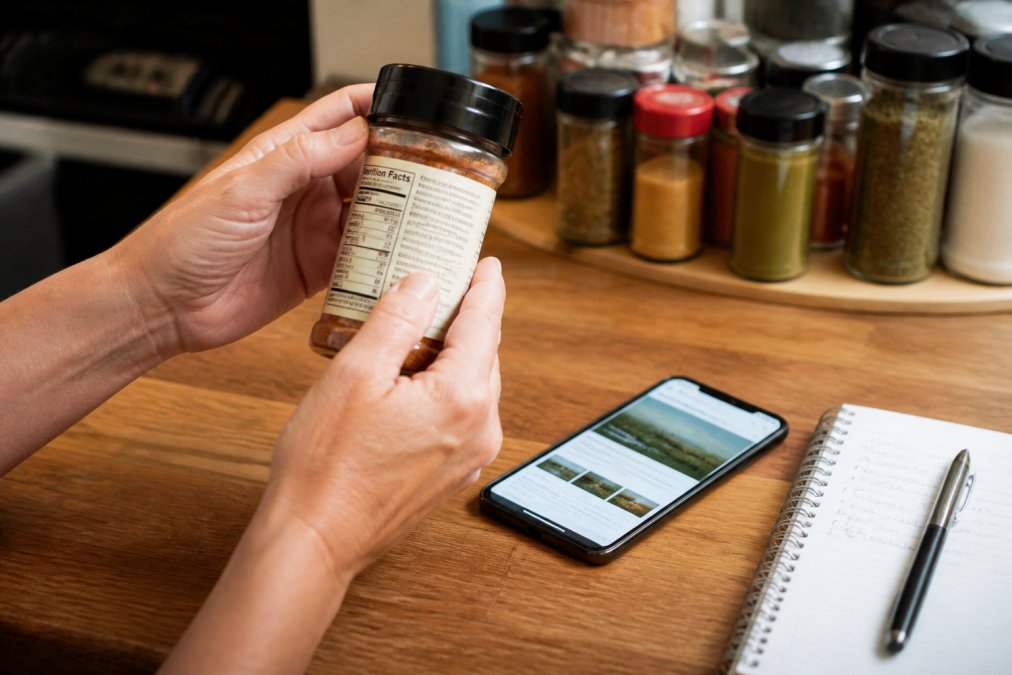
Step-by-Step: How to Verify Gluten Free Spices at the Store
Verifying gluten free spices takes about five minutes once you know the routine. This process works for both single spices and seasoning blends, and it applies whether you shop at a big-box grocery store or a specialty market.
Step 1: Check the Ingredient List First
Flip the package over and read the full ingredient list, not just the front label. Look specifically for wheat, barley, rye, malt, maltodextrin, wheat starch, and "natural flavors" without a source specified. If any of these appear, put the product back. If the ingredient list is clean, move to the next step.
Step 2: Look for Allergen Advisory Statements
Scan the packaging for allergen statements. Under FDA food allergen labeling regulations, wheat must be declared as an allergen when present. Advisory statements like "may contain wheat" are voluntary, so their absence is not a guarantee. A certified gluten-free seal from a third-party program is the strongest signal of safety.
Step 3: When in Doubt, Contact the Manufacturer
If the label is unclear or you are trying a new brand, send a quick message or email. A reputable company will answer whether they test for gluten and whether they use dedicated equipment. This step matters most for people with celiac disease who cannot tolerate even trace amounts.
| Verification Step | What to Look For | Red Flags |
|---|---|---|
| Ingredient List | Only recognizable spices and herbs | Wheat, barley, rye, maltodextrin |
| Allergen Statement | "Contains wheat" or "may contain wheat" | No allergen disclosure at all |
| Certification Seal | GFCO or similar third-party mark | "Gluten-free" claim with no testing info |
| Manufacturer Contact | Clear answers on testing and equipment | Vague or evasive responses |
High-Risk Spice Blends and Bulk Bin Dangers to Watch For
Pre-mixed seasoning blends carry the highest risk because they contain multiple ingredients, each with its own supply chain. But the danger does not stop at the store. The way you manage these products in your own kitchen is just as critical. Here is how to handle both the store-bought risks and the often-overlooked home cross-contamination problem.
The Bulk Bin Trap: More Than Just Shared Scoops
Bulk bins are a hazard for reasons beyond the shared scoop. The bins themselves are often refilled by pouring new product directly on top of old product, which means you could be buying spices that have been exposed to countless other shoppers' scoops. One shopper might use the scoop from the flour bin to get a spice, or a bin labeled "gluten-free" might be positioned directly below a wheat-based blend, with dust settling into the open container. The only safe rule: If you require strict gluten-free spices, never buy from bulk bins. The savings are not worth the risk.
The Home Kitchen Cross-Contamination Problem
Most guides stop at the store, but the risk continues in your pantry. Here is how gluten can sneak into your "safe" spices at home:
- The Double-Dip: Using a spoon that touched regular flour or a wheat-based seasoning and then dipping it into your gluten-free spice jar. This is the most common way spices become contaminated.
- The Shaker Over the Pot: Shaking a spice directly over a pot of food that contains gluten (like pasta) and then setting the shaker down. Steam and food particles can get into the shaker holes, and the next time you use it on a gluten-free dish, you introduce those particles.
- The Shared Shelf: Storing gluten-free spices on a shelf below gluten-containing flours. When you reach for the flour, dust settles onto the jars below. If the lids are not sealed tight, that dust can get inside.
Your Pantry Audit Checklist
To verify your spices are safe at home, perform this audit today:
- Step 1: Identify the Contaminated. Throw away any spice jar that has been double-dipped with a gluten-containing utensil. When in doubt, throw it out.
- Step 2: Change Your Pouring Habit. Never shake spices directly over a pot. Instead, pour a small amount into your hand or a small dish first, then add it to the food. This prevents steam and food particles from entering the jar.
- Step 3: Reorganize Your Pantry. Designate a specific shelf or cabinet for gluten-free items only. Place gluten-free spices on the top shelf, above any gluten-containing flours or mixes, to prevent dust from settling on them.
- Step 4: Clean the Containers. Wipe down the outside of your spice jars regularly, especially the lids, with a damp cloth. This removes any residue that may have settled on them.
- Step 5: Label Your Safe Spices. If you live in a shared kitchen, put a small dot of colored tape (e.g., green) on the lid of every spice that is verified gluten-free. This makes it instantly clear which jars are safe to use.
The Bottom Line: Trusted Sources for Worry-Free Seasoning
The most reliable way to verify gluten free spices is to buy from brands that build their entire process around gluten safety. Look for companies that use dedicated facilities, test their finished products, and clearly label their seasonings as gluten-free. When you find a brand you trust, stick with it and skip the guesswork.
At Twisted Pepper Co., every seasoning, BBQ rub, and dip mix is handcrafted and labeled gluten-free, with no added MSG and low or light sodium options. Our Savory Italian Seasoning and Tuscan Roasted Garlic Seasoning are perfect for bread dipping, grilled vegetables, and marinades, while the Garlic Jalapeno and Jalapeno Lime rubs bring heat. If you are looking for seasoning blends that skip the wheat-based fillers and anti-caking agents entirely, our lineup is built for worry-free cooking.

The key is to stop relying on assumptions and start verifying. Read labels, ask questions, and choose manufacturers who take gluten safety as seriously as you do. When you find those trusted sources, cooking flavorful gluten-free meals becomes simple again.
Frequently Asked Questions
Are McCormick spices certified gluten-free?
McCormick states that its single-ground spices do not contain gluten ingredients, and the company labels any product that contains wheat, barley, or rye. However, not every McCormick product carries a third-party certified gluten-free seal. You should still read the label each time, because manufacturing processes and formulations can change without notice.
What are hidden sources of gluten in seasoning blends?
Hidden gluten often appears in seasoning blends as anti-caking agents, wheat starch, maltodextrin (which can derive from wheat), or natural flavors that use barley. Soy sauce powder, which contains wheat, is another common culprit in spice mixes. Always scan the full ingredient list for wheat, barley, rye, and malt, and look for allergen statements.
Does the FDA regulate gluten-free labeling on spices?
Yes. The FDA regulates gluten-free labeling on all packaged foods, including spices and seasonings. A product labeled gluten free must contain less than 20 parts per million of gluten. This rule covers wheat, barley, and rye. However, the FDA does not require manufacturers to test every batch, so verification still matters.
Finding safe seasonings does not have to mean sacrificing flavor. Twisted Pepper Co. crafts every gluten-free dip mix, BBQ rub, and seasoning with dedicated attention to quality, using low and light sodium recipes and no added MSG. Explore our collection of handcrafted seasonings and discover how easy safe, delicious cooking can be. Shop now and get your favorites shipped fast to your door.