

How to Thicken Dry Soup Mixes Naturally Without Cornstarch
Last Updated: November 5, 2026
Quick Summary
To thicken dry soup naturally, add starchy ingredients such as torn bread, mashed potato, blended beans, or oats, then simmer until they release their starch. Start with small amounts and let the soup simmer a few minutes before judging the texture. Stirring in dairy off the heat adds richness too.
- Torn day-old bread added in the last 5 minutes releases starch for a hearty body.
- Mash one small cooked potato (about 5 ounces) or stir in 2 tablespoons of instant potato flakes.
- Blend 1/2 cup of cooked white beans with hot broth and simmer 5 minutes.
- Whisk ground flaxseed or chia into cold water first to avoid a gritty texture.
- Add cream, cream cheese, or butter off the heat, since dairy can break if boiled.
Table of Contents
- Why Dry Soup Mixes Turn Out Thin and What Thickens Them
- How to Thicken Soup With Bread for a Hearty Texture
- How to Thicken Soup Without Flour or Cornstarch
- How Much Cornstarch to Thicken Soup and How to Add It Without Lumps
- Blending Beans, Potato, and Vegetables Into Your Soup
- How to Fix Soup That Is Too Thin After Cooking
- Pick Your Next Batch: Start With Baked Potato or Broccoli Cheddar
- Frequently Asked Questions
Dry soup mixes often turn out thin, watery, and disappointing, especially when you follow the package directions to the letter, so learning how to thicken dry soup can make a real difference. The good news is that a few simple, natural techniques can give your bowl a richer, heartier body without reaching for cornstarch. At Twisted Pepper Co., we make handcrafted dry soup mixes, and we've learned a lot about how these blends behave once water hits the pot. This guide walks through practical ways to thicken your soup, plus the troubleshooting tips that make the difference.
Why Dry Soup Mixes Turn Out Thin and What Thickens Them
Dry soup mixes are designed to dissolve evenly, but that same design can leave a soup looking thinner than you expected. Dehydrated ingredients need time and heat to release their starches, and too little simmering time means less body in the final pot. Thickness starts with starch, so the best fix usually adds starch or releases the starch already in your ingredients.
Most thin soups come down to three causes, and knowing them is the first step toward learning how to thicken dry soup properly:
- Too much liquid for the amount of mix
- Too little simmer time for starches to swell
- Missing starchy ingredients like potato or beans
How to Thicken Soup With Bread for a Hearty Texture
Bread is one of the easiest natural thickeners you already have in the kitchen. Torn bread breaks down as it simmers, releasing starch that gives the soup a heartier, almost rustic body. This works especially well with brothy mixes that lack a creamy base.
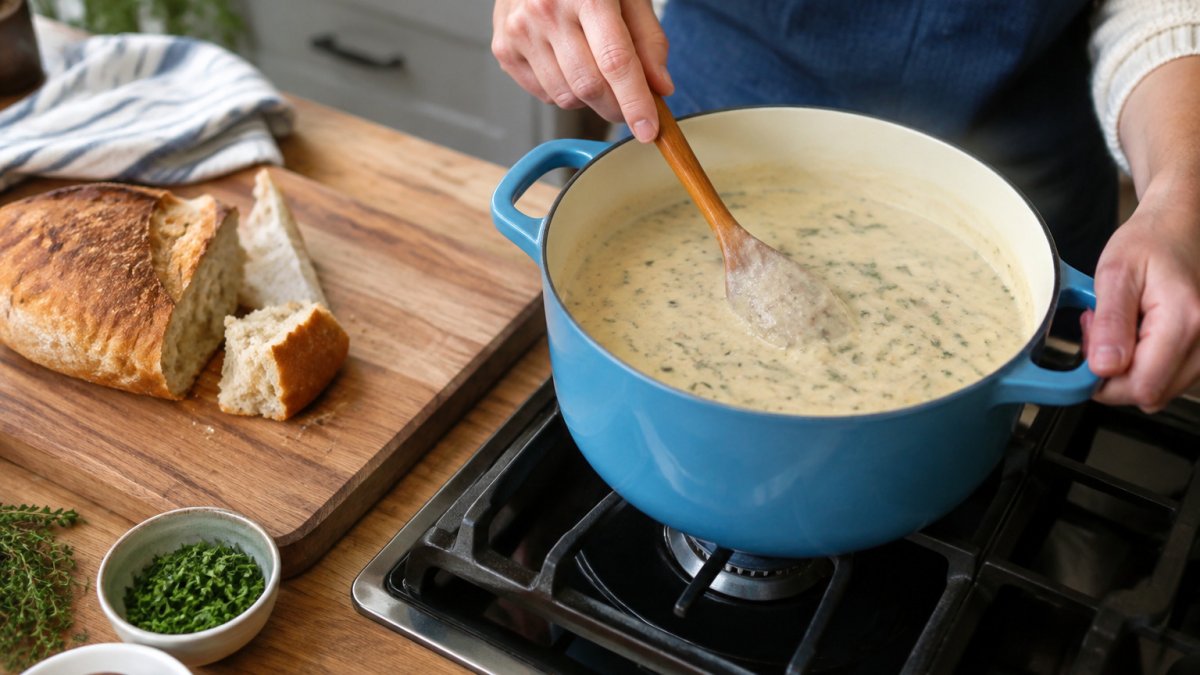
Try this method:
- Tear one to two slices of day-old bread into small pieces.
- Add the pieces to the simmering soup during the last 5 minutes of cooking.
- Stir gently until the bread softens and begins to dissolve.
- Taste and add more bread a little at a time if needed.
Watch out: bread can make soup gummy if you add too much, so start small.
How to Thicken Soup Without Flour or Cornstarch
Skipping refined starch does not mean settling for a watery bowl. The trick with a dry mix is that many of its ingredients are already starchy; they just need enough heat and time to release that starch. The options below are listed with starting amounts per 4 cups of prepared soup.
Potato. Mash one small cooked potato (about 5 ounces) into the pot, or stir in 2 tablespoons of instant potato flakes. Watch out: potato continues to swell as it sits, so add half the amount, stir, and wait 3 minutes before adding more.
Blended beans. A half cup of cooked white beans or cannellini, blended smooth with a ladle of hot broth, adds body and a mild creaminess. Return it to the pot and simmer 5 minutes. Start with 1/4 cup per 4 cups if the mix already contains legumes.
Oats. Stir in 3 tablespoons of rolled oats and simmer 10 minutes, until the oats are fully hydrated and no longer gritty. Quick oats turn gluey faster, so use 2 tablespoons.
Ground seeds and chia. Two tablespoons of ground flaxseed or chia seed, stirred in and left to sit 5 minutes, absorb liquid and add a slight gel body. Watch out: both can read as gritty if added dry to a hot pot, so whisk them into a little cold water first, the same way you would a slurry.
Egg yolks. Whisk one yolk with a ladle of hot soup, then stir it back into the pot off the heat. This adds richness and a velvety body but no real starch thickening, so it pairs best with a soup that is already close to the right consistency.
Dairy. Stir in cream, cream cheese, or butter at the end for richness. Dairy adds mouthfeel more than thickness, and it can break if boiled, so add it after the pot comes off the heat. For dairy-free mixes, full-fat coconut milk behaves similarly but carries a flavor that clashes with some blends.
Pureed vegetables from the mix itself. If the packet contains dried carrots, onions, or tomatoes, simmer 5 extra minutes and blend a cup of the soup.
A quick comparison for a 4-cup pot: instant potato flakes thicken fastest (2 minutes), oats and seeds need 5 to 10 minutes to hydrate, and beans and pureed vegetables need a full 5-minute simmer to blend in. Add any of these gradually, stir well, and give the pot 3 minutes between additions so you can judge the result before adding more.
The options below give starting amounts per 4 cups of prepared soup, so you can match the thickener to your pot.
| Option | Starting amount (per 4 cups) | Key note |
|---|---|---|
| Potato | 1 small cooked potato (about 5 oz) or 2 tbsp instant flakes | Swells as it sits; add half, wait 3 min |
| Blended beans | 1/2 cup cooked white beans, or 1/4 cup if mix has legumes | Blend with hot broth; simmer 5 min |
| Oats | 3 tbsp rolled oats, or 2 tbsp quick oats | Simmer 10 min until not gritty |
| Ground seeds and chia | 2 tbsp ground flaxseed or chia | Whisk into cold water first to avoid grit |
| Egg yolks | 1 yolk tempered with hot soup | Adds richness, little starch thickening |
| Dairy | Cream, cream cheese, or butter | Add off the heat; can break if boiled |
| Pureed mix vegetables | 1 cup blended after 5 extra min | Use dried carrots, onions, or tomatoes from the mix |
How Much Cornstarch to Thicken Soup and How to Add It Without Lumps
If you do choose cornstarch, a little goes a long way. For a standard pot of soup serving four to six, start with 1 tablespoon of cornstarch mixed into 2 tablespoons of cold water. Add more in small amounts only if the soup still looks thin.
To avoid lumps, always make a slurry first:
- Whisk the cornstarch into cold water until completely smooth.
- Bring the soup to a gentle simmer.
- Slowly drizzle the slurry into the soup while stirring.
- Simmer for 2 minutes to activate the starch.
Never add dry cornstarch straight into hot soup. It clumps instantly and is very hard to smooth out.
Blending Beans, Potato, and Vegetables Into Your Soup
Blending is often the simplest route to a thicker bowl. Cooked beans, potatoes, carrots, and onions all break down into a smooth base when pureed. Use an immersion blender right in the pot, or transfer a cup or two to a standard blender and return it.
A few pointers for best results:
- Blend only part of the soup so you keep some texture
- Let hot soup cool slightly before transferring to a blender
- Leave the lid slightly open so steam can escape
How to Fix Soup That Is Too Thin After Cooking
A thin pot after cooking usually points to one of four dry-mix-specific causes, and the right fix depends on which one you have. Diagnose before you add anything, because adding thickener to a pot that simply needs more simmer time is how soups turn gummy.
Cause 1: The dehydrated ingredients never fully rehydrated. Dried vegetables, lentils, and rice need more time than the package often states, especially at higher altitudes or in a shallow pot. If the vegetables are still firm, simmer uncovered 10 to 15 minutes more. The soup will thicken on its own as those ingredients release starch.
Cause 2: Too much liquid for the amount of mix. This is the most common cause with dry mixes, because the package directions assume a specific pot size and evaporation rate. If the broth tastes weak rather than just thin, you have over-diluted. The fix is to reduce, not to thicken: simmer uncovered 10 to 15 minutes so the liquid concentrates and the seasoning comes back into balance.
Cause 3: The starch is present but has not activated. Some mixes rely on potato flakes or cornstarch that need a full 2-minute simmer after the last addition to swell. If you added the mix at the end or kept the pot below a simmer, the starch is sitting there unactivated.
Cause 4: The soup will thicken as it cools. Starch-thickened soups set up noticeably in the bowl and in the fridge. If the pot looks slightly thin while hot, ladle a test bowl, let it sit 3 minutes, and taste. A soup that is perfect on the stove often turns pasty by the time it reaches the table.
Once you have identified the cause, add thickener in small increments: 1 tablespoon of instant potato flakes or 1 teaspoon of cornstarch in a slurry per 4 cups, stirred in and simmered 2 minutes before you taste again. Taste as you go, because thickening mutes salt and you may need a pinch more seasoning at the end. If the soup turns out too thick, thin it with a splash of water, broth, or milk rather than more of the mix, which would also concentrate the salt.
Two texture problems are worth knowing before they happen. Gumminess comes from over-thickening with starch or from boiling a starch-thickened soup hard after the slurry goes in; keep it at a gentle simmer. Graininess comes from undercooked grains or seeds, and the only fix is more simmer time, not more thickener.
Pick Your Next Batch: Start With Baked Potato or Broccoli Cheddar
If you want a thick, comforting bowl without the guesswork, our mixes do much of the work for you. Our Baked Potato Dry Soup Mix is thick and creamy, and you can add sour cream, bacon bits, or cheddar. Prefer something lighter? The Broccoli Cheddar Dry Soup Mix is rich and flavorful, and it comes together in minutes with water, milk, and chopped broccoli.
Planning a full week of cooking? Try our guide on how to batch cook healthy weeknight meals in 3 hours, or browse easy soup mixes for dinner for more quick ideas. Ready to start? Shop Now and taste the difference for yourself.

Frequently Asked Questions
What is the best thing to thicken soup?
For a dry soup mix, the most reliable natural options are blended cooked potato, pureed beans, and a small amount of plain bread. Potato adds body and creaminess, and Baked Potato Dry Soup Mix ($9.99) is a potato-based mix. Mashed potato or potato flakes can be stirred in during the last few minutes of simmering. Start with a small amount, let the soup simmer for 5 to 10 minutes, and check the texture before adding more.
Can bread thicken soup made from a dry mix?
Yes. A slice or two of plain white or whole-grain bread torn into small pieces will soften and break down as the soup simmers, adding body and a slightly heartier texture. Remove the crusts if you want a smoother result, and whisk or mash the bread into the liquid once it has softened. Bread works best in brothy mixes and adds the most body when the soup simmers for at least 10 minutes.
How much cornstarch should I use to thicken soup?
A common starting point is 1 tablespoon of cornstarch mixed with 2 tablespoons of cold water for every 2 cups of soup. Make the slurry first so it doesn't clump, stir it into the simmering soup, and cook for 1 to 2 minutes until the soup turns glossy. Add more in small increments if needed, since cornstarch thickens quickly and can become gummy if you overdo it.
How do I fix soup from a dry mix that is too thin?
Simmer the soup uncovered for 5 to 10 minutes so some liquid evaporates. If it is still thin, stir in a spoonful of mashed potato, a small amount of blended beans, or a slurry made from cornstarch and cold water. Adding extra dry mix in small amounts also works, though it will change the flavor more. Avoid adding more liquid, which only thins the soup further.
