

Low Sodium Dinners vs High Sodium Convenience Meals
Table of Contents
- How Low Sodium Dinners Compare to High Sodium Convenience Meals
- Sodium by the Numbers: Daily Intake Limit and Serving Size
- The Hidden Sodium in Processed Foods and Convenience Meals
- Reading the Nutrition Facts Label: A Practical Guide
- Low Sodium Meal Prep Ideas for Busy Weeknights
- The Best Low Sodium Seasonings for Cooking Without Salt
- Cost and Time: Convenience Meals vs Scratch Cooking
- Conclusion: Choosing Low Sodium Dinners That Fit Your Life
- Frequently Asked Questions
Last Updated: September 16, 2026
How Low Sodium Dinners Compare to High Sodium Convenience Meals
The gap between a home-cooked low sodium dinner and a frozen entree comes down to control: you decide what goes in the pan and how much. At Twisted Pepper Co., we build low and light sodium seasonings for exactly this reason, the sodium in most convenience meals is added before the food reaches your kitchen.
Sodium by the Numbers: Daily Intake Limit and Serving Size
The daily intake limit for sodium is 2,300 milligrams for most adults, according to the Dietary Guidelines for Americans. That is roughly one teaspoon of table salt for the entire day, and it covers everything you eat and drink, not just what comes out of the shaker.
| Label Term | What It Means Per Serving |
|---|---|
| Sodium-free | Less than 5 mg |
| Very low sodium | 35 mg or less |
| Low sodium | 140 mg or less |
| Reduced sodium | At least 25% less than the original |
| No salt added | No salt added during processing, but sodium may occur naturally |
The Hidden Sodium in Processed Foods and Convenience Meals
Hidden sodium in processed foods comes from more than the salt shaker: preservatives, flavor enhancers, leavening agents, and brine. That is why a food can taste only mildly salty and still be loaded with sodium.
Watch these categories in particular:
- Canned goods: soups, beans, and vegetables are often packed in salted water or broth
- Frozen entrees: sauces and gravies concentrate sodium
- Deli meats and cured products: brine and curing salts add up fast
- Breads and rolls: a single slice can contribute a surprising amount
- Condiments and bottled sauces: soy sauce, ketchup, and salad dressings
Reading the Nutrition Facts Label: A Practical Guide
Reading a nutrition facts label for sodium takes about 15 seconds once you know the three numbers that matter: serving size, sodium per serving, and servings per container.
Follow these steps in the grocery aisle:
- Find the serving size at the top of the label. Everything below it is based on that amount.
- Check servings per container. If it says 2 and you will eat the whole thing, double the sodium.
- Read the sodium line in milligrams. Compare it against the 140 mg low sodium threshold.
- Scan the ingredients list for sodium-containing additives: monosodium glutamate, sodium benzoate, sodium nitrite, disodium inosinate, and sodium phosphate.
- Compare two similar products side by side and pick the lower number.
The 15-Second Label Math
The label number is rarely the number you eat. Run this calculation before anything goes in your cart.
- Sodium per serving × servings you will actually eat = sodium on your plate.
- A frozen entree listing 640 mg per serving with 2 servings per container is 1,280 mg if you eat the whole tray, more than half the 2,300 mg daily limit in one meal.
- A canned soup listing 480 mg per half-cup with 2.5 servings per can is 1,200 mg for the can.
- A deli sandwich built from 2 slices of bread (about 230 mg), 3 oz of sliced turkey (about 570 mg), and 1 tbsp of mayo (about 90 mg) lands near 890 mg before you add cheese, pickles, or chips.
What to Look For on Common Convenience Items
| Convenience Item | Where Sodium Hides | What to Compare |
|---|---|---|
| Canned soup | Broth base, flavor enhancers | Regular vs. 'no salt added' or 'reduced sodium' |
| Frozen entree | Sauce, gravy, seasoning packet | Sodium per serving vs. servings per container |
| Deli meat | Brine, curing salts | 'Lower sodium' varieties; check per 2 oz |
| Frozen pizza | Crust, cheese, sauce, pepperoni | Sodium per slice vs. per whole pizza |
| Boxed rice or pasta kit | Seasoning packet | Sodium with vs. without the packet |
| Canned beans and vegetables | Packing liquid | 'No salt added' vs. regular; rinse reduces surface sodium |
Label Terms That Do Not Mean What You Think
A common mistake is reading "reduced sodium" as "low sodium." Reduced only means at least 25% lower than that brand's regular version, a soup at 900 mg reduced to 675 mg is still a heavy hit. "Lightly salted" has no regulated definition tied to the 140 mg threshold, so treat it as a flavor claim.
A Two-Product Walkthrough
Say you are choosing between two frozen chicken dinners. Product A lists 510 mg per serving, 1 serving per container. Product B lists 380 mg per serving, 2 servings per container. Product A looks higher, but you eat all of B: 760 mg. Product A wins on the number that reaches your plate, normalize to what you eat, then compare.
Low Sodium Meal Prep Ideas for Busy Weeknights
Low sodium meal prep ideas work best when you build a base once and season each portion differently, so dinner does not taste like leftovers by Thursday: cook a neutral protein and grain in bulk, roast a tray of vegetables, then finish each plate with a distinct low sodium seasoning.
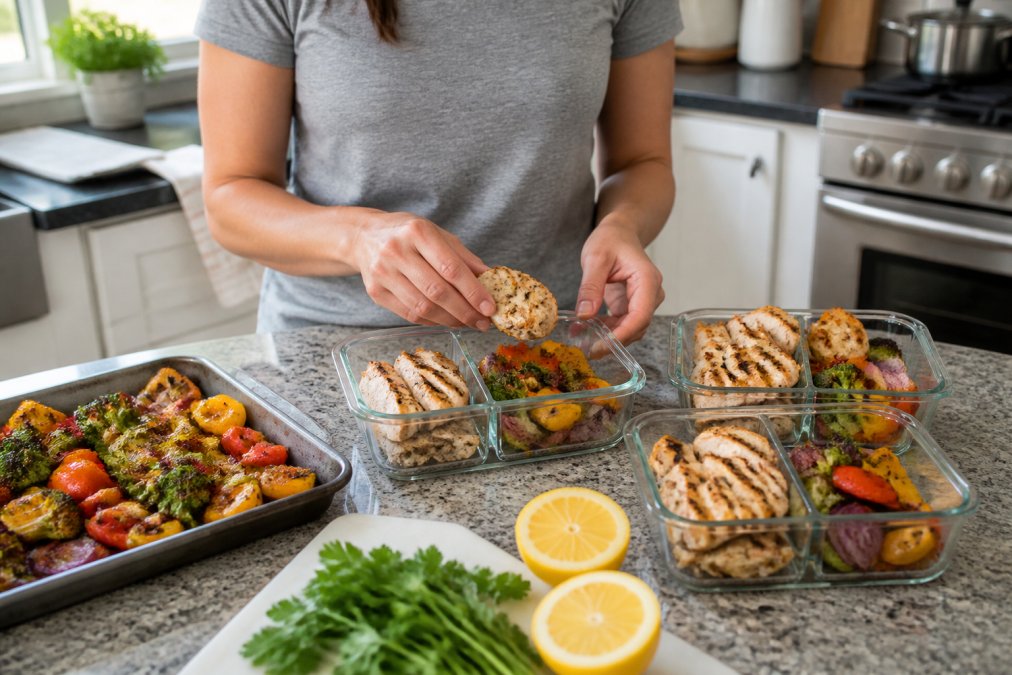
Try this rotation:
- Sunday base: grill or bake chicken, cook a pot of rice or quinoa, roast a sheet pan of peppers and onions
- Monday: chicken and rice bowl finished with a garlic-forward Italian blend
- Tuesday: the same chicken shredded into a quick saute with tomatoes and herbs
- Wednesday: roasted vegetables over grains with a bread-dipping style oil
- Thursday: a 30-minute soup built from the remaining vegetables and broth
The Best Low Sodium Seasonings for Cooking Without Salt
The best low sodium seasonings for cooking replace salt with layered flavor, aromatics, heat, acid, and herbs, so the palate registers complexity instead of a missing ingredient. Potassium chloride substitutes help some people, though they carry a metallic edge.
Tuscan Roasted Garlic Seasoning 2.0 oz. →
| Approach | Flavor Profile | Best For |
|---|---|---|
| Potassium chloride substitute | Salty, slightly metallic | People told to cut sodium sharply |
| Single dried herbs | Clean but flat alone | Finishing, not building |
| Acid (lemon, vinegar) | Bright, sharp | Cutting richness |
| Handcrafted low sodium blend | Layered, balanced | Everyday cooking and meal prep |
Cost and Time: Convenience Meals vs Scratch Cooking
Most comparisons of low sodium dinners and high sodium convenience meals stop at "cooking takes time, convenience costs money." The real trade-off is more specific, and once laid out, the time argument weakens. Mastering the art of improving bland meals transforms basic ingredients into satisfying dinners without requiring the excessive salt found in processed alternatives.
The Honest Trade-Off
| Factor | Convenience Meals | Scratch Cooking |
|---|---|---|
| Time to plate | 4-8 minutes (microwave or oven) | 20-30 minutes with a prepped base |
| Active time | Under 1 minute | 10-15 minutes |
| Sodium control | None after purchase | Full |
| Cost per serving | Often $3-$6 per entree | Often $1.50-$3 per plate in bulk |
| Flavor control | Fixed by the manufacturer | Yours to adjust |
| Flexibility | One meal per package | One base, several dinners |
| Waste | Packaging per meal | Bulk ingredients, less packaging |
Those ranges are typical grocery-store figures, not promises. The pattern holds: convenience meals cost more per serving and hand every sodium decision to the manufacturer.
The Time Argument, Examined
The convenience pitch is that scratch cooking costs 30 minutes you do not have. True on a single night with no prep, not true once you have a base in the fridge.
- 3-4 cups of cooked grains (rice, quinoa, or farro)
- 2-3 pounds of cooked protein (grilled chicken, browned ground turkey, or roasted tofu)
- A sheet pan of roasted vegetables
The Cost Side
Convenience meals are priced for the convenience, not the food. A frozen entree at $4 is roughly $4 per serving; the same ingredients in bulk, rice, a family pack of chicken, frozen vegetables, often land between $1.50 and $3 per plate. Over a week of dinners for one person, that difference is real money.
The Barrier Nobody Names
For anyone managing blood pressure or heart health, that control is the point. The time and cost gaps are smaller than the packaging suggests; the sodium gap is not.
Conclusion: Choosing Low Sodium Dinners That Fit Your Life
The choice between low sodium dinners and high sodium convenience meals is not about virtue. It is about who holds the seasoning spoon. Convenience meals hand that decision to a factory; cooking at home keeps it in your kitchen, where a good blend does the heavy lifting.
Frequently Asked Questions
What is a good low sodium meal for dinner?
A good low sodium dinner starts with fresh produce and a protein you season yourself. Try grilled chicken or fish with roasted vegetables, or a 30-minute soup built from low sodium broth and your own spice blend. The key is controlling the sodium at the seasoning stage rather than relying on a packaged sauce or frozen entree. A dinner you season yourself can land well under 600 milligrams of sodium per serving, compared with 1,200 milligrams or more in many frozen meals.
How much sodium is considered high in a single convenience meal?
The daily intake limit is 2,300 milligrams of sodium, according to the Dietary Guidelines for Americans. A single convenience meal with 800 milligrams or more delivers roughly a third of that limit in one sitting, and many frozen entrees, canned soups, and boxed dinners exceed 1,000 milligrams per serving. Check the nutrition facts label and compare the serving size to what you actually eat. If you eat the whole package, multiply the sodium by the number of servings inside.
What are some easy ways to season food without using salt?
Salt substitutes built on potassium chloride work for some people, but they carry a metallic aftertaste. A more flexible approach is layering low sodium seasonings for cooking: garlic, Italian herbs, chiles, smoked paprika, and citrus zest. Twisted Pepper Co. makes several low sodium, gluten-free, no MSG blends, including Tuscan Roasted Garlic Seasoning ($6.99) and Cow Hide Rub ($10.49), that add flavor without leaning on salt. Finish with a squeeze of lemon or a splash of vinegar to brighten the dish.
How can I make quick low sodium dinners at home?
Start with low sodium meal prep ideas that save time later: cook a batch of grains, roast a tray of vegetables, and portion proteins on Sunday. During the week, combine those components with a low sodium seasoning and a fast cooking method like sauteing or grilling. The Twisted Pepper Co. Tuscan Roasted Garlic Seasoning works as a marinade with olive oil, a dip base, or a dry sprinkle, so one jar covers several dinners. Most meals come together in 30 minutes or less once the prep is done.
Are there convenience foods that are low in sodium?
Yes, but you have to read labels carefully. Look for frozen vegetables without sauce, plain frozen seafood, no salt added canned goods, and plain rice or grains. These items skip the preservatives and food additives that drive sodium up in processed foods. Pair them with a low sodium seasoning blend instead of a packaged sauce, and you get the speed of a convenience meal with a fraction of the sodium. The nutrition facts label is your fastest filter: aim for items under 140 milligrams per serving.