

How to Store Dry Rubs to Keep Them Fresh
Table of Contents
- How to Store Dry Rubs to Keep Them Fresh: Quick Start
- What You'll Need
- How Long Does Dry Rub Last?
- How to Prevent Spices from Clumping
- Best Containers for Spice Storage
- Where to Store Dry Rubs: Pantry, Freezer, or Fridge
- Desiccant Packets and Other Pro Tips
- Common Mistakes to Avoid
- Frequently Asked Questions
Last Updated: October 3, 2026
How to Store Dry Rubs to Keep Them Fresh: Quick Start
Learning how to store dry rubs to keep them fresh comes down to three things: keep moisture out, keep heat and light away, and use a container that actually seals. At Twisted Pepper Co., we blend and ship handcrafted rubs, and those rules decide whether a rub tastes sharp six months from now or flat in six weeks.
Dry rubs are blends of ground spices, herbs, salt, and sugar used to season meat and vegetables before cooking. Freshness depends on protecting the volatile oils that carry flavor.
Here's the quick version:
- Move rubs out of the bag they shipped in and into an airtight container
- Store in a cool, dark, dry spot, ideally between 60°F and 70°F
- Keep them away from the stove, oven, and dishwasher
Most people lose flavor to steam and heat, not age. Fix those two and your rubs last far longer.
What You'll Need
You don't need much to store dry rubs properly:
- Airtight glass jars with rubber gaskets or clamp lids
- Small funnel for refilling shaker bottles
- Labels and a marker for dating
Skip anything that can't seal tight. A folded bag with a chip clip lets air in and out every time you open the cabinet, causing clumping.
How Long Does Dry Rub Last?
A well-stored dry rub keeps its best flavor for about six months to a year after opening. Sealed and unopened, many blends hold quality for up to two years. After that, they're safe but taste dull.
The shelf life depends on three things:
- Ingredients: Salt and dried chiles hold up longer than onion powder and garlic powder, which cake first.
- Packaging: A vacuum-sealed bag beats a zip-top bag every time.
- Storage spot: A cool dark place beats a shelf above the stove.
Sugar-heavy rubs are the exception. Sugar pulls moisture from the air, so those blends clump faster and need tighter seals.
Signs Your Rub Is Past Its Prime
Your nose is the best test. A fresh rub smells bright and strong; a tired rub smells dusty or faint.
Other signs:
- Hard clumps that won't break with a fork
- Color that has faded from deep red or brown to pale tan
- No aroma when you rub a pinch between your fingers
If the rub smells fine but looks clumpy, break it up and use it soon. Clumping alone means damp, not spoiled.
How to Prevent Spices from Clumping
Clumping happens when moisture gets into the jar and the powders stick together. Stop moisture before it starts:
- Never scoop with a wet spoon or damp fingers
- Pour rub into a small bowl first, then season, so steam never touches the jar
- Keep the jar closed between uses, even during a long cook
- Add a food-grade desiccant packet to blends that cake often
- Store away from the sink, dishwasher, and stovetop
If a rub already clumps, spread it on a sheet pan, air-dry for an hour, then break it up with a fork. Don't bake it; heat drives off the oils you're trying to save.
Best Containers for Spice Storage
The best container for dry rubs is a small glass jar with an airtight seal and a wide mouth. Glass doesn't hold odors, stain, or react with salt or acidic blends.
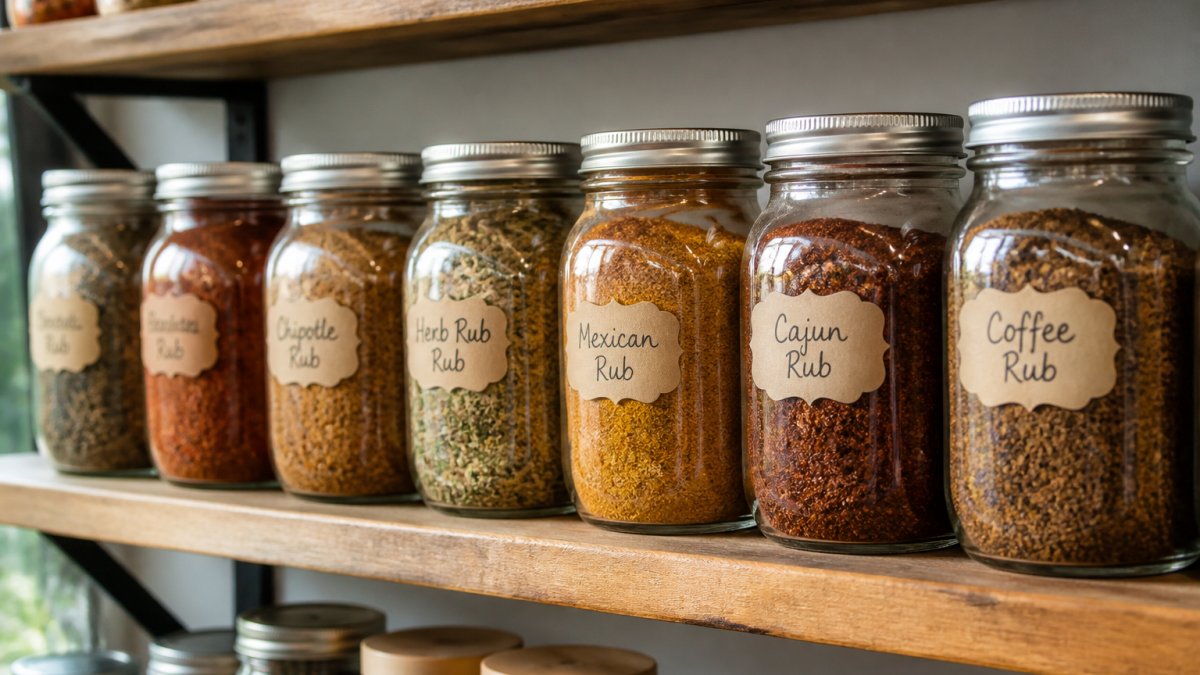
Look for:
- Rubber gasket or silicone seal
- Clamp or screw lid that locks tight
- Opaque glass or a dark cabinet spot to block light
Small is better than big. A half-empty jar holds more air, and more air means faster flavor loss. If you buy in bulk, keep a small working jar and refill it from a larger sealed container.
Mason Jars vs. Plastic Bags
Mason jars win for anything you plan to keep longer than a month. The glass seals tight, blocks odors, and doesn't let flavor escape through the walls.
Plastic bags and thin tubs have two problems: they're porous over time, so aroma leaks out, and zip seals wear out after repeated opening.
That said, bags have a place. The resealable pouch your rub ships in works fine for the first few weeks if you press out the air and store it flat in a dark drawer.
| Container | Seal Quality | Best For | Watch Out For |
|---|---|---|---|
| Mason jar | Excellent | Long-term storage | Breakage |
| Clamp-lid glass jar | Excellent | Daily use | Gasket wear |
| Shaker bottle | Good | Cooking station | Small capacity |
| Zip-top bag | Fair | Short-term, travel | Seal wear |
| Vacuum-sealed bag | Best | Bulk backup | Needs a sealer |
Where to Store Dry Rubs: Pantry, Freezer, or Fridge
The pantry is the best home for dry rubs in most kitchens, but the freezer and fridge each have a narrow role, and a specific failure mode most guides gloss over. Here's how the three spots compare, and why temperature fluctuation matters more than the absolute number on your thermometer.
Pantry: The Default Choice
A dry pantry shelf away from heat and light keeps blends stable for months. Target 60°F to 70°F with low humidity. Two spots to avoid:
- Above or beside the stove. Radiant heat from the oven and steam from boiling pots raise both temperature and humidity in that zone. A cabinet directly above a range can swing 15°F or more during a long cook.
- Above the dishwasher. The vent releases hot, moist air every cycle. Same problem, different appliance.
A lower cabinet on an interior wall, away from exterior walls that sweat in humid months, is the steadiest spot in most kitchens.
Freezer: For Bulk Backup Only
The freezer is useful for bulk rubs you won't touch for months.
When you pull a cold jar from the freezer, the air around it cools rapidly.
The fix is simple but non-negotiable: let the jar come to room temperature before you open it.
A second freezer risk is repeated thaw-refreeze cycles: every warm-open-refreeze drives moisture migration inside the powder.
Fridge: The Worst of the Three for Daily Use
The fridge is the most humid of the three, and every open-close cycle pulls moist air into the jar. Temperature is also unstable, the door shelf can swing 10°F or more each time it opens.
One narrow use case: small amounts of a rub you'll finish within a few weeks in a very humid climate where the pantry is above 60% relative humidity.
The Real Variable: Temperature Stability
The exact storage temperature matters less than how much it fluctuates. A cabinet steady at 72°F preserves a rub better than a spot swinging between 55°F and 80°F, because every swing drives moisture migration inside the powder and accelerates loss of volatile oils. Pick a steady spot, and check it with a cheap thermometer if you're not sure.
| Location | Temperature | Humidity | Best For | Main Risk |
|---|---|---|---|---|
| Pantry (interior wall) | 60-70°F, stable | Low | Everyday jars | Heat from nearby appliances |
| Freezer | 0°F or below | Low | Bulk backup | Condensation on thaw |
| Fridge (back of shelf) | 35-40°F, swings | High | Short-term, humid climates | Moisture from door cycles |
Desiccant Packets and Other Pro Tips
Desiccant packets are the most underused tool in dry rub storage. Silica gel is a porous form of silicon dioxide with millions of microscopic pores; each pore grabs water molecules from the surrounding air through adsorption, holding them on the surface. That means the packet pulls humidity out of the jar's headspace before it can reach your onion powder or brown sugar.
Choosing the Right Desiccant
Not all desiccants are equal or safe near food.
- Food-grade silica gel is the standard choice. Look for packets explicitly labeled "food safe" or "food grade" on the packaging. Industrial silica gel often contains moisture indicators (cobalt chloride) that are not meant for food contact.
- Clay desiccants are also food-safe and work well, but they hold less moisture per gram than silica gel.
- Molecular sieve packets are the most aggressive moisture grabbers, but they're overkill for a spice jar and harder to find in small sizes.
Sizing and Placement
A common pattern is roughly 1 gram of silica gel per 1 to 2 cups of jar volume for a container opened regularly. A pint mason jar holds about 2 cups, so a 1-gram packet is plenty.
Place the packet on top of the rub, not buried in it, you want it exposed to the headspace air, where the moisture lives. Buried, the surrounding powder blocks airflow and the packet works slower.
When to Replace Them
Silica gel packets saturate over time, then stop pulling moisture and can even release it back if the jar warms. There's no reliable visual cue on most food-grade packets, so swap them every three to six months, or any time the rub starts to cake despite a tight seal. You can recharge some silica gel in a low oven, but food-grade packets are usually cheap enough to just replace.
Other Habits That Extend Shelf Life
- Label and date every jar. Write the blend name and the date you opened it, painter's tape and a Sharpie work fine.
- Rotate your stock. New jars go behind old ones so you use the oldest first, the same first-in-first-out system commercial kitchens use.
- Watch ingredient lists. Blends heavy on onion powder, garlic powder, or brown sugar cake first because those ingredients are hygroscopic, they pull moisture from the air. Check those jars more often and consider a desiccant packet even in a small jar.
Common Mistakes to Avoid
The biggest storage mistake is leaving rubs in the bag they came in. Once that seal is broken, air and moisture get in every time you open it.
Other mistakes we see often:
- Storing rubs on the shelf above the stove, where heat and steam rise
- Scooping with wet hands or a damp spoon
- Keeping a giant jar that's mostly air
Fix these and your rubs stay sharp. It's less about fancy gear and more about a tight seal and a smart spot.
Frequently Asked Questions
Do dry rubs go bad?
Yes, dry rubs lose potency over time. While they don't spoil like fresh food, the volatile oils that give spices their flavor degrade. Most blends stay fresh for 6 months to 2 years if stored in an airtight container in a cool, dark place. After that, they're safe to eat but taste flat. Always check for faded color and weak aroma.
How far in advance can you apply dry rub?
You can apply dry rub up to 24 hours before cooking. For best results, apply it 30 minutes to 2 hours ahead and let the meat sit in the refrigerator. The salt in the rub draws out moisture and then reabsorbs, carrying flavor deeper. Leaving it longer than 24 hours can make the surface mushy or too salty.
Does refrigerating dry rubs prevent clumping?
Refrigeration can actually cause clumping. When you take a cold jar out of the fridge, condensation forms inside, adding moisture that makes spices stick together. Instead, store dry rubs in a cool, dark pantry away from heat sources like the stove or dishwasher. If your kitchen runs hot, a basement shelf or a closet works better.
What is the best container for storing BBQ rubs?
Glass mason jars with airtight lids are the best choice. They don't absorb odors, don't stain, and keep moisture out. Look for jars with a rubber gasket or a tight-sealing lid. If you prefer plastic, choose food-grade containers with a silicone seal. Avoid thin plastic bags or shaker bottles that don't close securely.
Good seasoning deserves good storage. If your rubs clump or fade, the fix is simple: seal them tight, keep them cool and dark, and date every jar. Twisted Pepper Co. makes that easy with handcrafted, gluten-free, no-MSG-added rubs and seasonings, plus low and light sodium options for cooks who want control. Every blend ships fast to your door and works in 30-minute meals. Shop now and keep your next batch tasting as bold as the day it arrived.