

Cook Gourmet Meals on a Budget: 7 Chef Techniques
Table of Contents
- What Gourmet on a Budget Actually Means
- Build Budget Gourmet Recipes Around Affordable Ingredients
- Master Budget-Friendly Meal Planning for Gourmet Results
- Chef Techniques to Make Cheap Meals That Taste Expensive
- Three 30-Minute Budget Gourmet Recipes You Can Make Tonight
- Stretch Your Ingredients: Batch Cook and Repurpose Leftovers
- Common Mistakes That Sabotage Budget Gourmet Cooking
- Frequently Asked Questions
Last Updated: October 20, 2026
What Gourmet on a Budget Actually Means
Gourmet meals on a budget aren't about fancy restaurants or expensive ingredients, they're about technique, flavor layering, and smart shopping. At Twisted Pepper Co., great taste comes from building depth with affordable staples, not premium prices.
Expensive doesn't mean delicious. A $3 chicken breast seared properly beats a mediocre $15 cut cooked poorly. Gourmet cooking on a budget means maximizing flavor from inexpensive proteins, pantry staples, and seasonal vegetables.
Build Budget Gourmet Recipes Around Affordable Ingredients
The secret to gourmet meals on a budget starts with the right foundation. Not all cheap ingredients are equal, some deliver massive flavor for pennies, others taste thin and forgettable.
Proteins That Deliver Flavor Without the Price Tag
Chicken thighs cost less than breasts but taste richer thanks to more fat.
Eggs are the most underrated protein, a frittata with roasted vegetables and seasoning becomes restaurant-quality for under $2 per serving.
Beans and lentils deliver protein and fiber for pennies. Canned beans work fine, just rinse to reduce sodium.
Affordable fish like canned tuna or frozen cod work too, season boldly, pair with bright sauces, and let the seasoning do the heavy lifting.
Pantry Staples That Transform Simple Meals
Rice and pasta are your foundation: cheap, shelf-stable, and willing to take on whatever flavors you add. Never serve them plain.
Canned tomatoes become the base for countless gourmet sauces, one can, some garlic, and quality seasoning creates depth that tastes like hours of cooking.
Dried herbs and spices matter more than you think, a pinch of quality seasoning transforms bland rice into something memorable. At Twisted Pepper Co., we craft blends like our Savory Italian Seasoning specifically for this, layering Italian spices to deliver restaurant flavor without the restaurant price tag.

Olive oil, vinegar, and garlic are your flavor multipliers, cheap individually, complex when combined.
Master Budget-Friendly Meal Planning for Gourmet Results
Planning changes everything. Random shopping leads to waste; strategic planning means buying ingredients that work across multiple meals, cutting cost per serving and minimizing spoilage.
Plan Around Sales and Seasonal Produce
Seasonal vegetables cost half as much as out-of-season ones. In summer, build meals around tomatoes and zucchini.
Check sales before planning: chicken thighs on sale means three meals around them that week; discounted pasta means two pasta dinners.
Buy vegetables that store well, carrots, onions, potatoes, and cabbage last weeks in the fridge, stay affordable, and work in dozens of dishes.
Calculate Cost Per Serving to Stay on Track
Here's what most budget guides skip: actual math. A $12 meal for four costs $3 per serving, gourmet territory.
Track your costs: add up ingredients, divide by servings. You'll quickly see which meals deliver the most flavor for the least money.
The formula: ingredient cost ÷ servings = cost per serving. Aim for $2-4 per serving for gourmet results on a real budget.
Chef Techniques to Make Cheap Meals That Taste Expensive
Technique is the difference between a cheap meal and a gourmet one. Your ingredients are already capable of restaurant-quality results, what separates them is how you apply heat, salt, acid, and fat.
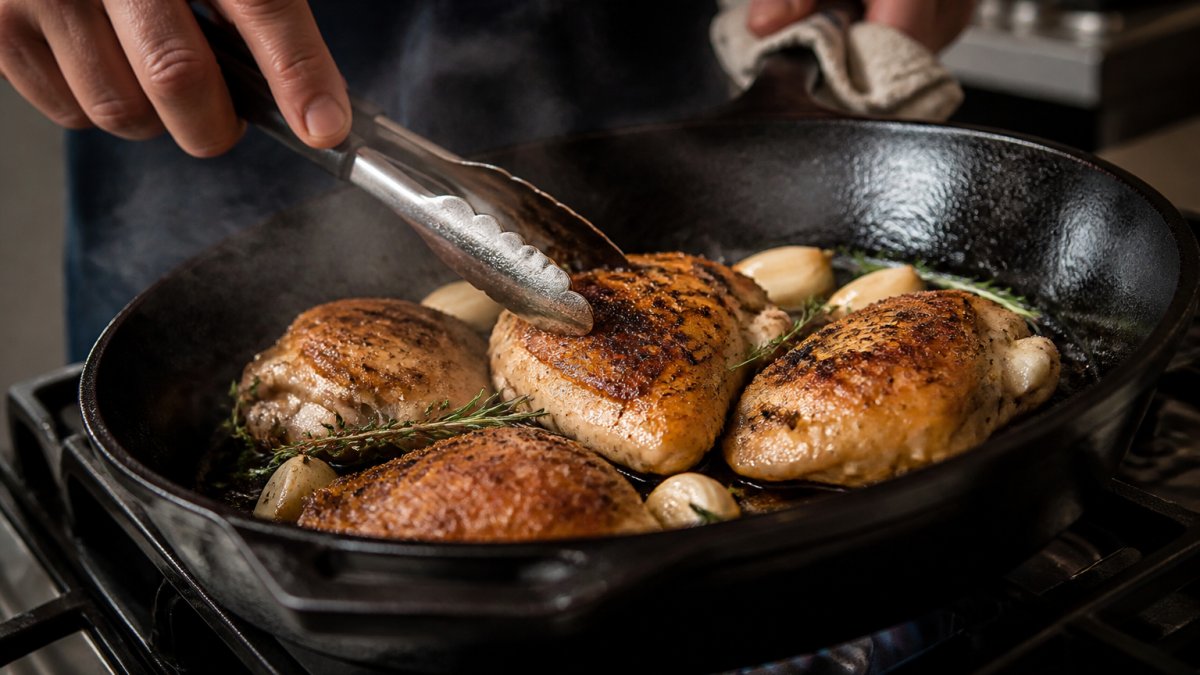
Sear for the Maillard Reaction, Not Just for Color
The Maillard reaction is the browning when proteins and sugars hit high heat, producing hundreds of new flavor compounds. That crust is where "expensive" flavor lives, but it only happens above roughly 300°F on the surface, and stops the moment moisture gets in the way.
- Dry the surface first. Pat proteins completely dry with paper towels. Surface water has to evaporate before browning can start, so a wet piece of chicken steams instead of sears.
- Get the pan hot before the food goes in. Heat a cast-iron or heavy stainless skillet over medium-high for 2-3 minutes, then add a thin film of oil with a high smoke point. The oil should shimmer, not smoke heavily.
- Leave space. Crowding drops the pan temperature and traps steam. Cook in batches if needed; the extra 5 minutes is the whole difference.
A $3 chicken thigh seared this way develops more flavor than a $15 cut cooked on medium heat and stirred constantly. The technique is free; patience is the cost.
Bloom Spices in Fat to Release Their Oils
Ground spices carry flavor compounds in fat-soluble oils, so stirring cumin or paprika into a cold liquid leaves much of that flavor locked in the powder.
- Heat 1-2 tablespoons of oil or butter over medium heat.
- Add the ground spices and stir constantly for 30-60 seconds, until fragrant. Do not let them scorch; burnt spices turn bitter and cannot be rescued.
- Add your aromatics or liquid immediately to stop the cooking.
A pinch of cumin bloomed in oil tastes noticeably stronger than the same pinch stirred into a cold pot, one of the cheapest flavor upgrades available, costing nothing but a minute of attention.
Build a Pan Sauce from the Fond
After searing protein, the browned bits stuck to the pan, the fond, are concentrated flavor. Deglazing with a splash of liquid lifts them into a sauce, the classic restaurant move that turns a plain chicken thigh into a plated dish.
- Pour off excess fat, leaving about a tablespoon.
- Add a splash of stock, wine, or even water and scrape the bottom with a wooden spoon until the fond dissolves.
- Simmer to reduce by about half, then finish with a small knob of cold butter or a drizzle of olive oil off the heat to give the sauce body.
- Taste and adjust with salt and a squeeze of lemon.
The sauce costs pennies and makes the plate feel finished.
Balance With Acid and Finish With Freshness
Fat and salt make food rich; acid makes it taste alive. A squeeze of lemon, splash of vinegar, or spoonful of yogurt at the end brightens heavy dishes and makes budget ingredients, beans, potatoes, pasta, taste deliberate rather than plain. Finish with fresh herbs or citrus zest, since much of what we perceive as flavor is actually smell.
Layer Salt at Every Stage
Salting only at the end gives you a flat, salty surface. Season the protein before searing, salt the aromatics as they soften, and adjust at the end. Each stage builds depth, and the total salt you need actually goes down because it's distributed through the dish.
Savory Italian Seasoning 4.0 oz →
The Technique-at-a-Glance Table
| Technique | Budget Ingredient | What It Does | Time Required |
|---|---|---|---|
| Searing (Maillard) | Chicken thighs, ground turkey | Builds browned, savory crust | 6-8 minutes |
| Blooming spices | Ground cumin, paprika, blends | Releases fat-soluble oils | 30-60 seconds |
| Deglazing | Pan fond + stock or wine | Turns browned bits into sauce | 3-5 minutes |
| Balancing acid | Lemon, vinegar, yogurt | Cuts richness, brightens flavor | 10 seconds |
| Layered salting | Any protein or vegetable | Builds depth throughout | Throughout cooking |
None of these techniques requires specialty equipment or expensive ingredients, only attention, the one thing a budget cook can always afford.
Three 30-Minute Budget Gourmet Recipes You Can Make Tonight
These three recipes show the technique section in action, each with a transparent cost breakdown: ingredient quantities, total recipe cost, cost per serving, and the assumptions behind the numbers. Prices vary by store and region, so treat these as a worked example you can swap with your own receipts. Assumptions: a 1-pound package of dried pasta, a 15-ounce can of beans, and a 28-ounce can of diced tomatoes at typical national supermarket prices; pantry oil, salt, and pepper costed at a few cents per use; and no specialty items required.
Tuscan Garlic Pasta with Roasted Vegetables
Serves 4. Time: 25 minutes.
- 12 ounces dried pasta (penne or rigatoni)
- 1 medium zucchini, diced
- 1 bell pepper, sliced
Method: Heat the oven to 425°F. Toss the zucchini, bell pepper, and cherry tomatoes with 1 tablespoon olive oil, the herb blend, salt, and pepper. Roast 15 minutes.
Cost breakdown (approximate): pasta $1.25; zucchini $0.75; bell pepper $1.00; cherry tomatoes $2.00; garlic $0.25; oil, herbs, and seasonings $0.50. Total: about $5.75. Cost per serving: about $1.45.
Italian Bean and Pasta Soup (Pasta e Fagioli)
Serves 6. Time: 30 minutes.
- 1 tablespoon olive oil
- 1 small onion, diced
- 2 cloves garlic, minced
Method: Heat the oil in a pot over medium heat and cook the onion until soft, about 5 minutes. Add the garlic and herbs and cook 30 seconds.
Cost breakdown (approximate): beans $0.90; diced tomatoes $1.50; pasta $0.60; onion and garlic $0.40; oil and seasonings $0.30; optional Parmesan $0.50. Total: about $4.20. Cost per serving: about $0.70.
Creamy Baked Potato Soup with Budget Add-Ins
Serves 4. Time: 25 minutes.
- 2 tablespoons butter or olive oil
- 1 small onion, diced
- 2 cloves garlic, minced
Method: Melt the butter in a pot over medium heat and cook the onion until soft, about 5 minutes. Add the garlic and cook 30 seconds.
Cost breakdown (approximate): potatoes $0.80; onion and garlic $0.40; stock $0.50; butter and milk $0.60; optional toppings $0.75. Total: about $2.30 without toppings, $3.05 with. Cost per serving: about $0.58-$0.76.
To adapt these to your own store, keep a running list of the unit price of your ten most-used staples. Once you know what pasta, beans, potatoes, onions, and canned tomatoes cost per pound or per can, you can re-cost any recipe in about two minutes and spot which meals give you the most flavor per dollar.
Stretch Your Ingredients: Batch Cook and Repurpose Leftovers
Batch cooking multiplies your budget. Cook once, eat three times, this isn't wasteful, it's smart.
Cook a large pot of rice or pasta on Sunday. Use it as a base for three different meals:
- Monday: Mix with roasted vegetables and a simple sauce
- Wednesday: Combine with leftover protein and seasoning for a stir-fry
- Friday: Layer into a casserole with tomato sauce and cheese
Roasted vegetables work the same way. Cook a sheet pan of mixed vegetables.
Leftover proteins transform easily. Shredded chicken becomes tacos, pasta sauce, or soup. Ground meat becomes chili, pasta sauce, or stuffed peppers.
The key: season differently each time. Same ingredients, different seasonings, feel like different meals.
Common Mistakes That Sabotage Budget Gourmet Cooking
Most home cooks make the same errors that keep budget meals tasting cheap.
Skipping the sear. Cooking proteins on medium heat saves time but loses flavor.
Under-seasoning. Budget ingredients need bold seasoning to shine.
Using old spices. Spices lose potency after 18 months.
Ignoring aromatics. Garlic, onions, and herbs are cheap flavor multipliers. Never skip them.
Buying pre-cut vegetables. They cost twice as much and spoil faster.
Gourmet meals on a budget aren't a compromise, they're a skill. Get started with handcrafted, gluten-free seasonings designed for bold flavor and easy 30-minute meals, Shop Now.
| Technique | Budget Ingredient | Flavor Impact | Time Required |
|---|---|---|---|
| Searing | Chicken thighs | High | 8 minutes |
| Blooming spices | Dried seasonings | High | 1 minute |
| Layering aromatics | Garlic, onions | High | 5 minutes |
| Batch cooking | Rice, pasta, vegetables | Medium | 30 minutes prep |
| Seasoning blends | Mixed spices | High | 0 minutes |
Frequently Asked Questions
How can I make inexpensive ingredients taste gourmet?
Use proper searing and layering techniques: sear proteins hard to build a flavorful crust, build aromatics (garlic, onions) into your base, and finish with quality seasoning blends like Tuscan Roasted Garlic or Savory Italian Seasoning. These techniques create restaurant-quality depth without expensive ingredients. Add fresh herbs or a squeeze of lemon at the end for brightness that makes budget meals feel refined.
What are the cheapest foods to buy for gourmet cooking on a budget?
Rice, pasta, beans, eggs, and seasonal vegetables form your foundation. Chicken thighs (cheaper than breasts) deliver more flavor. Canned tomatoes, broth, and dried herbs are pantry workhorses. Buy these staples in bulk during sales. Combine them with handcrafted seasoning blends, like Pasta e Fagioli Dry Soup Mix ($9.99) or Baked Potato Dry Soup Mix ($9.99), to create meals that cost $2-3 per serving but taste like they cost twice that.
How can I plan gourmet meals without wasting ingredients?
Build your meal plan around 3-4 core ingredients you'll use across multiple dishes. If you buy chicken, use it in a stir-fry one night and shred it into soup the next. Plan one 'fridge raid' night per week where you repurpose leftovers into frittatas, casseroles, or grain bowls. Shop your pantry before buying new items. Calculate cost per serving as you plan so you stay aware of waste and portions.
Can I make restaurant-quality meals in 30 minutes on a tight budget?
Yes. Use pre-mixed soup bases and seasoning blends to skip prep time, Pasta e Fagioli is ready in 30 minutes or less. Focus on high-impact techniques: sear proteins hard, build aromatic bases, and finish with fresh elements. Buy pre-cut vegetables if your budget allows (the time savings justify it). Handcrafted, low-sodium seasoning blends like Tuscan Roasted Garlic ($6.99) add depth that would take 30 minutes to build from individual spices.